
Thinking About an Adjustable-Rate Mortgage? Start With How Long You'll Stay.


More move-up buyers in Orange County are asking about ARMs. The lower starting rate is real. Whether it works for you depends on a question only you can answer.
"Should we take the ARM?" We're hearing it more often from move-up buyers this fall, usually right after a lender shows them what an adjustable-rate mortgage does to the payment on an Orange County home. Here's what's worth understanding before you sit down with a lender.
Why ARMs are back in the conversation
It isn't only our clients asking. In the week ending October 23, adjustable-rate loans made up 11.3% of mortgage applications, the highest share in more than a year, according to the Mortgage Bankers Association's weekly applications survey.
The draw is the starting rate. The same survey put the average 5/1 ARM at 6.41%, compared with 7.37% for a conforming 30-year fixed and 7.28% for a jumbo 30-year fixed. A fixed rate never changes. An ARM is locked for the first several years, then it can move up or down with the market.
What an adjustable-rate mortgage saves on an Orange County move-up
Here's a simple illustration. Say you sell your current home and buy a $2 million home in Costa Mesa or Newport Beach with 20% down. That's a $1.6 million loan.
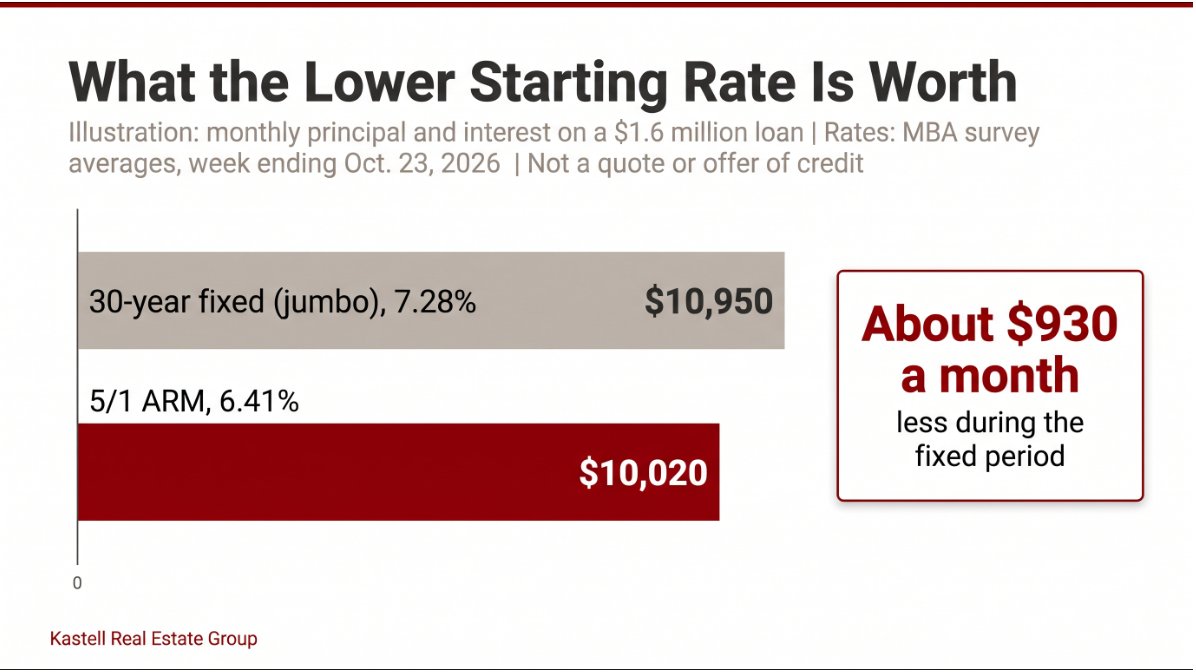
At 7.28% fixed, principal and interest come to about $10,950 a month. At 6.41%, it's about $10,020. That's roughly $930 a month, or about $55,700 over a five-year fixed period.
These figures use national survey averages. They aren't a quote or an offer of credit, and they cover principal and interest only, before property taxes and insurance. Your actual rate depends on your lender and your loan. A loan that size is a jumbo loan here (above Orange County's $1,249,125 conforming limit for 2026), and each jumbo lender sets its own ARM pricing and terms. We explained how jumbo rates are priced in our post on the mortgage rate spread.
How the reset works
The fixed period is usually five, seven or ten years. After that, most ARMs today adjust every six months, based on a market index plus a set margin. You'll see them written as 5/6, 7/6 or 10/6.
Caps limit how far the rate can move. A common setup on five-year ARMs is 2/1/5: up to 2 points at the first adjustment, 1 point at each one after, and no more than 5 points above the starting rate over the life of the loan. On many seven- and ten-year ARMs, the first adjustment can go the full 5 points.
Here's the $1.6 million example after five years:
- Rate unchanged (6.41%): about $10,020 a month
- At the first cap (8.41%): about $11,960, roughly $1,000 more than the fixed payment
- At the lifetime cap (11.41%): about $15,110
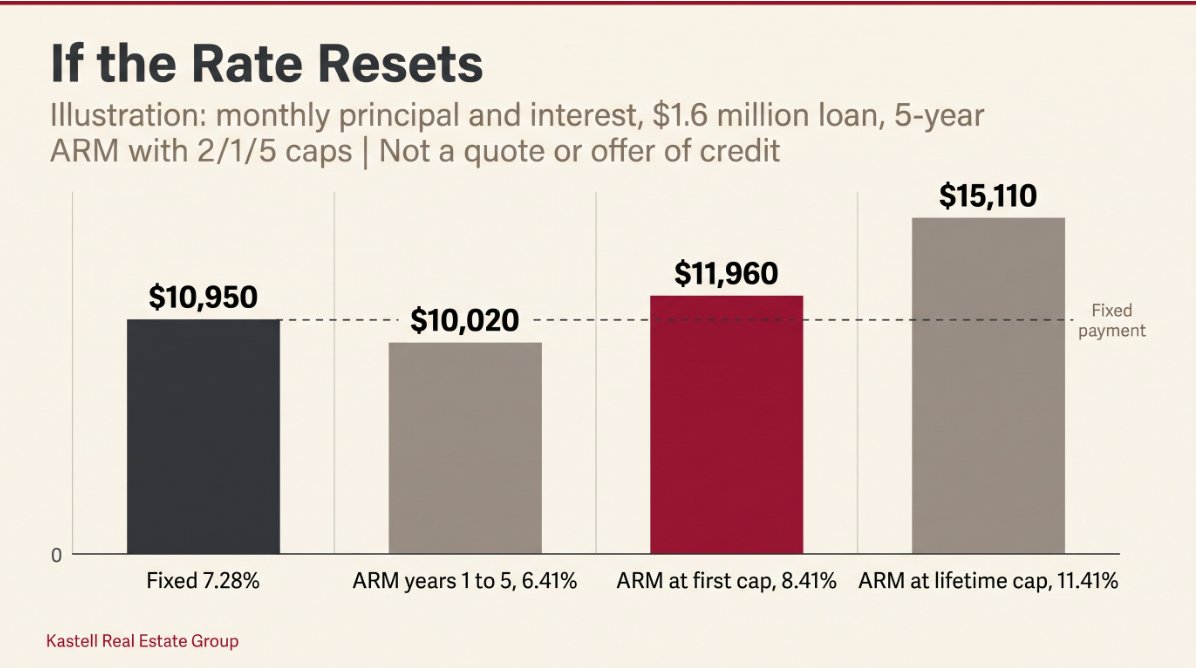
The cap isn't a forecast. It shows the most the payment could rise, which is why it's worth seeing in writing.
The honest question for move-up buyers
ARMs are generally designed for people who expect to sell or refinance before the reset. So the first question isn't the rate. It's how long you'll stay.
Californians tend to stay put. Redfin's homeowner tenure study found the typical owner in the Los Angeles area had been in their home 19.4 years, and in San Diego 14.7, compared with 11.8 nationally. Orange County wasn't broken out, but owners here have the same reason to stay: Prop 13 limits how fast your home's assessed value can rise for as long as you own.
Move-up homes are often the ones people mean to keep. If "five years, then we'll see" really means fifteen, tell your lender. That changes which loan options are worth comparing.
Plan for the refinance, too
When the reset comes, you can keep the loan, refinance into a fixed rate or a new ARM, or sell. A refinance is a brand-new loan, though. You'll need to qualify again on your income, debts and credit at that time.
That matters if you expect a big change in the next few years, like retirement, selling a business or moving to one income. Ask your lender what the reset payment would look like if refinancing weren't an option.
Today's ARMs are also underwritten more carefully than the ones that went wrong in 2008. Under the federal Ability-to-Repay rule, lenders have to verify your income and assets and consider what you could owe after the starting rate ends, not only the first payment.
Questions to bring to your lender
- How long is the fixed period, and how often does the rate adjust after that?
- What index is it tied to, and what's the margin?
- What are the caps at the first adjustment, each one after and over the life of the loan?
- What would my payment be at the first cap and at the lifetime cap?
- Is there a prepayment penalty?
Planning a move-up? We're happy to talk through the timing on both sides, selling and buying. For the loan itself, a licensed mortgage professional is the right person to compare your options. No pressure, no pitch.
This post is general information, not financial, tax or legal advice. Kastell Real Estate Group is not a mortgage lender. Rates and payments shown are illustrations based on published survey averages, not a quote or an offer of credit. Talk with a licensed mortgage professional about your situation.
Bernice DeVries | Broker | Kastell Real Estate Group | Costa Mesa & Newport Beach
Recent Posts








GET MORE INFORMATION